3.1 Control Plane vs Agent Execution Plane
3.2 Project Scope Model
3.3 Data Flow: Source -> Release -> Pipeline -> Logs/Artifacts
3.4 Runtime Configuration Layers (global / project / environment)
3.5 Pipeline Execution Semantics
3.6 Release Governance Path
3.7 Rollback Architecture (Policy-driven)
3.8 Security and Trust Boundaries
3.9 State and Persistence Model
3.10 Scalability Model
3.11 Failure Modes and Recovery Patterns
3.12 Why This Architecture Works in Practice
14.1 Rollback Policy Overview
Orbnetes deployment and release orchestration documentation for operators and platform teams.
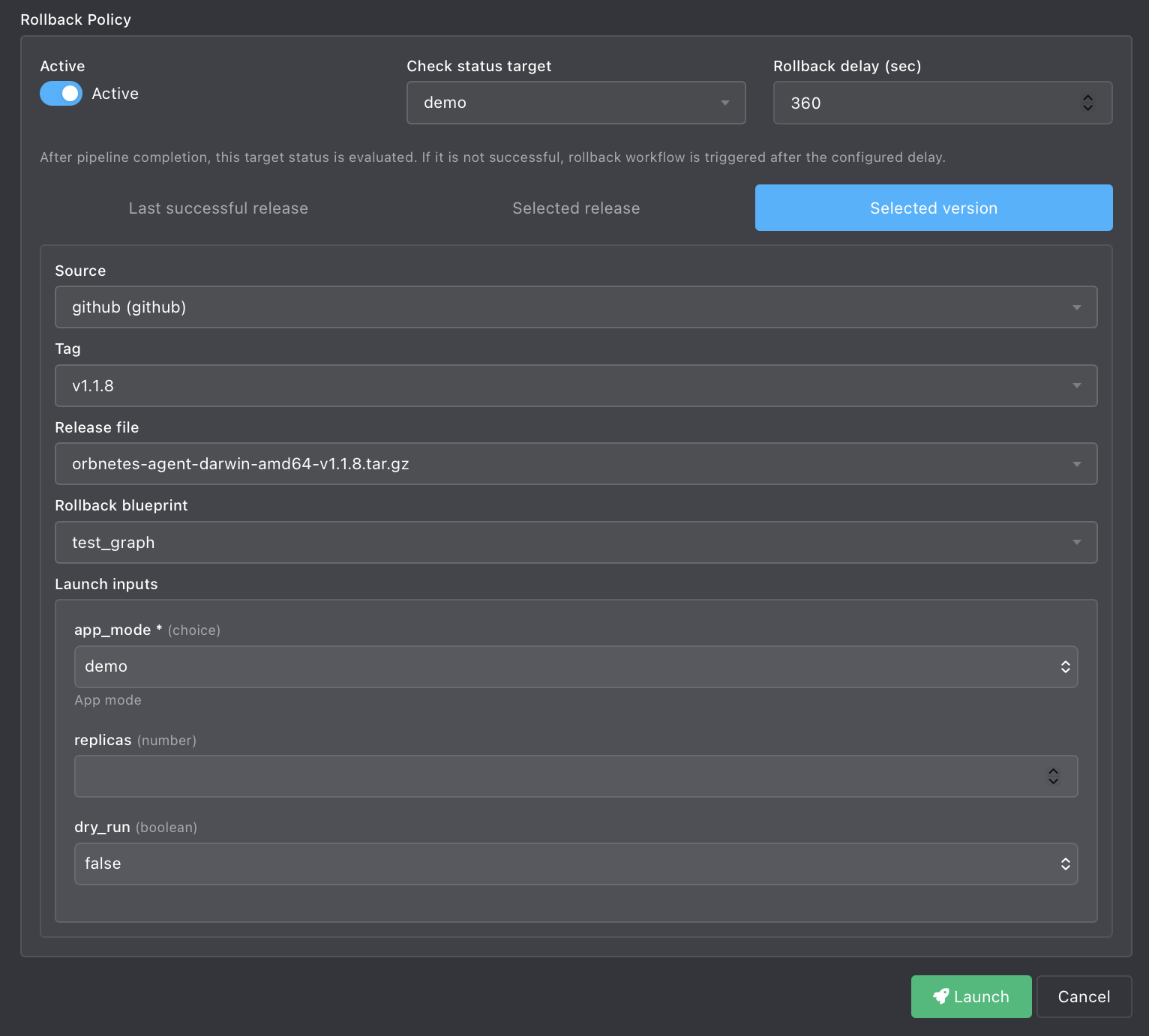
Rollback in Orbnetes is policy-driven release recovery. Instead of ad-hoc manual commands during incident pressure, rollback behavior can be defined at release creation time and executed consistently when failure conditions are met.
Core objective:
- reduce recovery time,
- preserve auditability,
- avoid improvisation in high-stress situations.
Rollback Policy is configured on release form and stored with release metadata.
Typical policy fields:
- enabled (on/off),
- check target (pipeline or specific job),
- delay seconds (wait before evaluating/executing),
- rollback mode (where rollback source comes from).
Execution model:
- Release runs normally.
- System evaluates configured failure condition.
- If condition indicates failure, rollback task is scheduled after delay.
- Rollback is executed as a new release with linked origin context.
Why this model is useful:
- rollback becomes repeatable and deterministic,
- all actions are visible in release history,
- teams can pre-approve recovery strategy before failure occurs.