3.1 Control Plane vs Agent Execution Plane
3.2 Project Scope Model
3.3 Data Flow: Source -> Release -> Pipeline -> Logs/Artifacts
3.4 Runtime Configuration Layers (global / project / environment)
3.5 Pipeline Execution Semantics
3.6 Release Governance Path
3.7 Rollback Architecture (Policy-driven)
3.8 Security and Trust Boundaries
3.9 State and Persistence Model
3.10 Scalability Model
3.11 Failure Modes and Recovery Patterns
3.12 Why This Architecture Works in Practice
11.1 Standalone Runs vs Pipelines
Orbnetes deployment and release orchestration documentation for operators and platform teams.
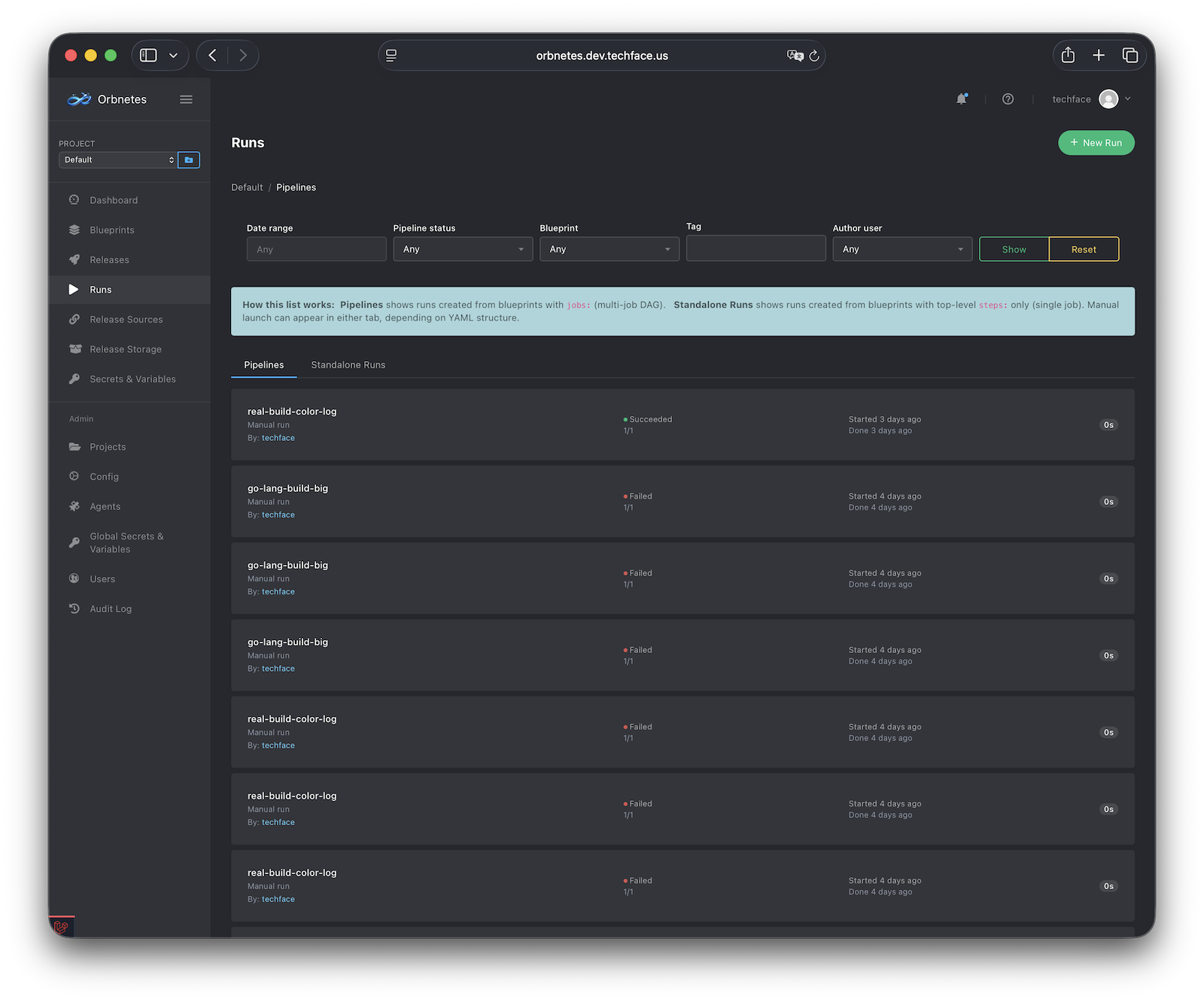
This section explains how Orbnetes executes blueprints in runtime and how operators monitor and recover execution safely.
At a high level:
- a blueprint launch creates executable jobs,
- jobs may form a pipeline (DAG) or a single standalone flow,
- operators use graph/live pages to monitor and manage execution,
- rerun and artifact capabilities support fast recovery.
Orbnetes supports two execution views:
Standalone Runs
Used when running a blueprint directly (non-release context) or when viewing individual job-run execution pages.
- Focus: direct operational run.
- Typical use: ad-hoc task, utility operation, quick validation flow.
- Scope: single launch context, often without release governance layer.
Pipelines
Used when jobs are linked by DAG metadata and represented as one pipeline execution.
- Focus: orchestrated multi-job flow with dependency graph.
- Typical use: deployment lifecycle (backup -> deploy -> verify), multi-stage CI/CD-like flows.
- Scope: multiple jobs with clear relationships and shared pipeline ID.
Operational note:
- A single logical pipeline may contain multiple job runs.
- Standalone run pages remain the deep-dive surface for step-level live diagnostics.