3.1 Control Plane vs Agent Execution Plane
3.2 Project Scope Model
3.3 Data Flow: Source -> Release -> Pipeline -> Logs/Artifacts
3.4 Runtime Configuration Layers (global / project / environment)
3.5 Pipeline Execution Semantics
3.6 Release Governance Path
3.7 Rollback Architecture (Policy-driven)
3.8 Security and Trust Boundaries
3.9 State and Persistence Model
3.10 Scalability Model
3.11 Failure Modes and Recovery Patterns
3.12 Why This Architecture Works in Practice
11.3 Pipeline Graph (DAG)
Orbnetes deployment and release orchestration documentation for operators and platform teams.
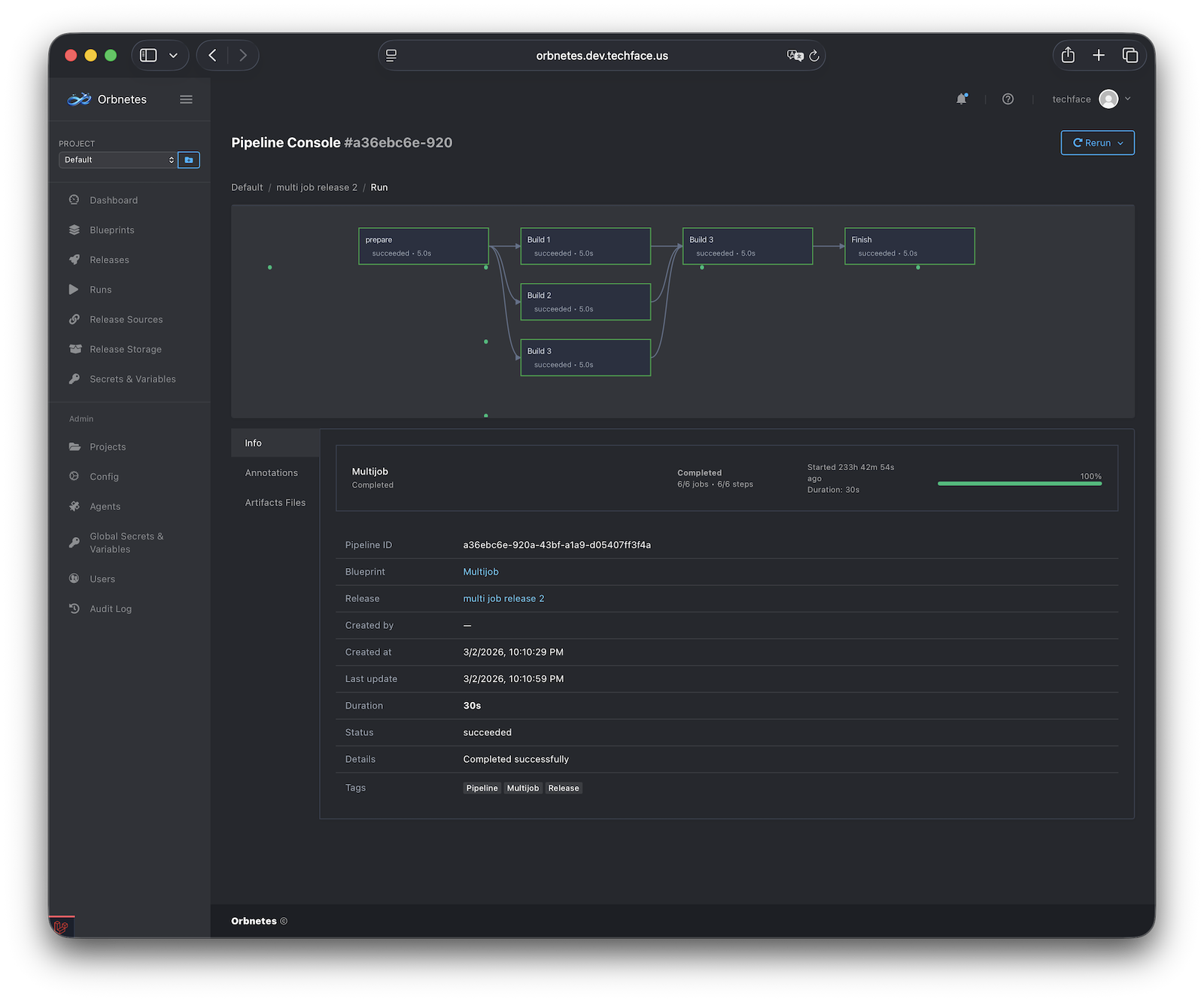
The pipeline graph is the primary real-time topology view of execution.
What it shows:
- jobs and their dependency edges (
needs), - state transitions (waiting/running/succeeded/failed/canceled),
- parallel branches and blocked nodes,
- execution progress context.
Why it matters operationally:
- quickly identify bottlenecks and blocked dependencies,
- understand where failure occurred in chain,
- verify expected order and branch behavior,
- reduce incident triage time.
Graph-driven workflow:
- detect failed or stuck node,
- open node/job live page,
- inspect step logs,
- choose rerun strategy.