3.1 Control Plane vs Agent Execution Plane
3.2 Project Scope Model
3.3 Data Flow: Source -> Release -> Pipeline -> Logs/Artifacts
3.4 Runtime Configuration Layers (global / project / environment)
3.5 Pipeline Execution Semantics
3.6 Release Governance Path
3.7 Rollback Architecture (Policy-driven)
3.8 Security and Trust Boundaries
3.9 State and Persistence Model
3.10 Scalability Model
3.11 Failure Modes and Recovery Patterns
3.12 Why This Architecture Works in Practice
11.2 Launch Flows
Orbnetes deployment and release orchestration documentation for operators and platform teams.
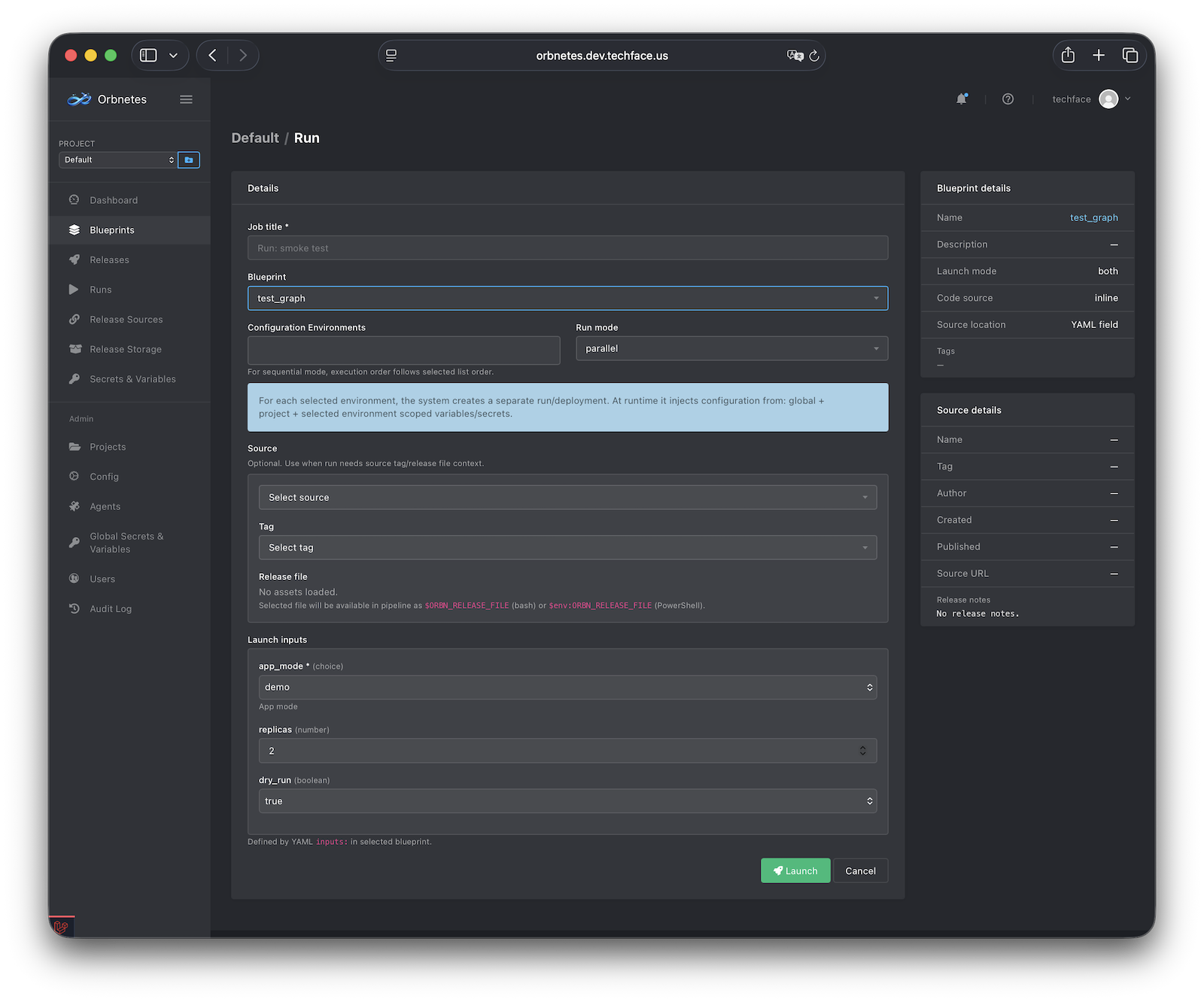
Primary launch paths:
Blueprint Launch (Run)
- Choose blueprint.
- Fill launch inputs.
- Optionally choose configuration environments.
- Start run.
- Observe pipeline/run pages.
Release Launch
- Choose source/tag/file.
- Choose blueprint.
- Fill launch inputs.
- Select environments and deployment mode.
- Optional approvals and rollback policy.
- Start release execution (or wait for approvals).
What launch flow determines:
- runtime context (release-linked or standalone),
- available metadata in logs/pages,
- governance gates (approvals),
- environment-scoped config injection.
Best practice:
- use standalone launch for operational utility tasks,
- use release launch for deploy workflows requiring traceability/governance.